
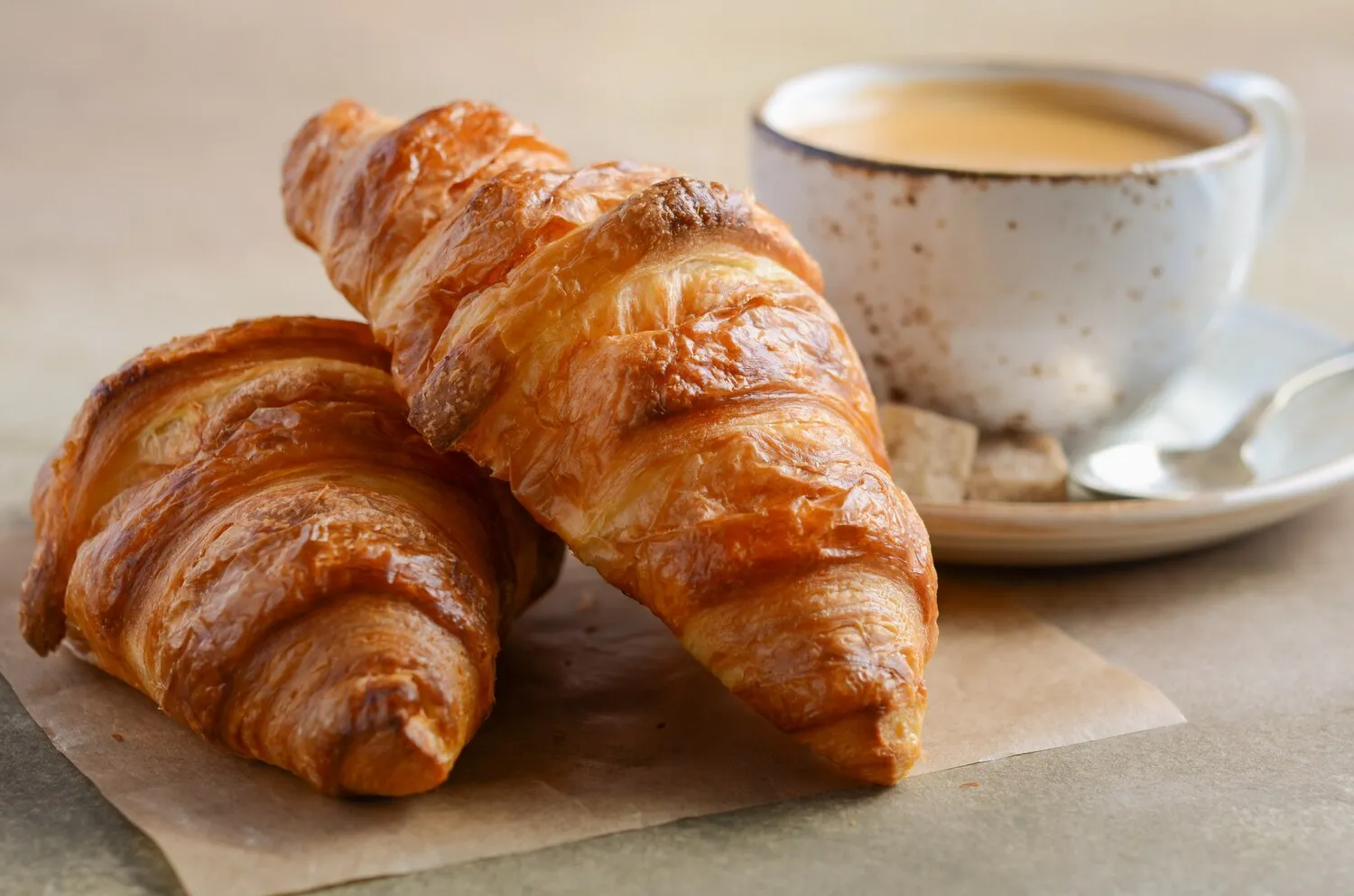

Croissant
A buttery, flaky pastry.
Valeurs Nutritionnelles
* Le % de la valeur quotidienne (VQ) vous indique la quantité d'un nutriment dans une portion d'aliment qui contribue à un régime quotidien. 2 000 calories par jour sont utilisées pour les conseils nutritionnels généraux.
Fonctionnalité Premium
St.Jakobs Stenugnsbageri
Fonctionnalité Premium
While often associated with France, the croissant's ancestor is believed to be the Austrian Kipferl. The legend states that the Kipferl was created in Vienna to celebrate the Austrian victory over the Ottoman Empire in 1683, resembling the crescent moon on the Ottoman flag. Marie Antoinette, an Austrian princess who married into the French royal family, is often credited with introducing the Kipferl to France, where it evolved into the modern croissant.
Fonctionnalité Premium
The croissant is deeply ingrained in French culinary culture, often enjoyed as a breakfast staple or a midday snack.
Breakfast Staple
In France, croissants are a common breakfast item, often paired with coffee or hot chocolate. They are typically purchased fresh from a boulangerie (bakery) each morning.
Boulangerie Culture
The croissant is a hallmark of French boulangeries. The quality of a boulangerie is often judged by the quality of its croissants.
Café Society
Enjoying a croissant at a café is a quintessential Parisian experience, providing a moment of relaxation and indulgence.
Fonctionnalité Premium
The croissant is characterized by its rich, buttery flavor and delicate, flaky texture.
The primary flavor comes from the high butter content, which contributes to its richness and creates layers of flaky dough through lamination. There's a subtle sweetness, enhanced by the baking process, which caramelizes the sugars in the dough and butter. A good croissant has a light, airy interior and a crisp, golden-brown exterior. The fermentation process in the dough also contributes to a subtle tangy and complex flavor profile.
Fonctionnalité Premium
Butter Quality is Key
Use high-quality butter with a high fat content (at least 82%) for the best flavor and lamination. European-style butter is often preferred.
Temperature Control
Keep the dough and butter cold throughout the lamination process to prevent the butter from melting and absorbing into the dough. Work in a cool environment.
Proper Lamination
Achieve consistent layers by laminating the dough correctly – folding and rolling it multiple times with butter in between. This creates the flaky texture.
Proofing is Essential
Allow the croissants to proof properly before baking. They should almost double in size. Over-proofing can cause them to collapse in the oven, while under-proofing results in a dense, less airy texture.
Baking at the Right Temperature
Bake at a high temperature initially to create steam and allow the croissants to rise quickly. Then, lower the temperature to ensure they are cooked through without burning.
Fonctionnalité Premium
Explorez des plats et restaurants supplémentaires de Pastry
Explorer PastryDécouvrez les meilleurs restaurants et expériences culinaires à Malmö.
Explorer MalmöEn savoir plus sur la culture gastronomique, la scène des restaurants et le patrimoine culinaire de Sweden.
Explorer Sweden